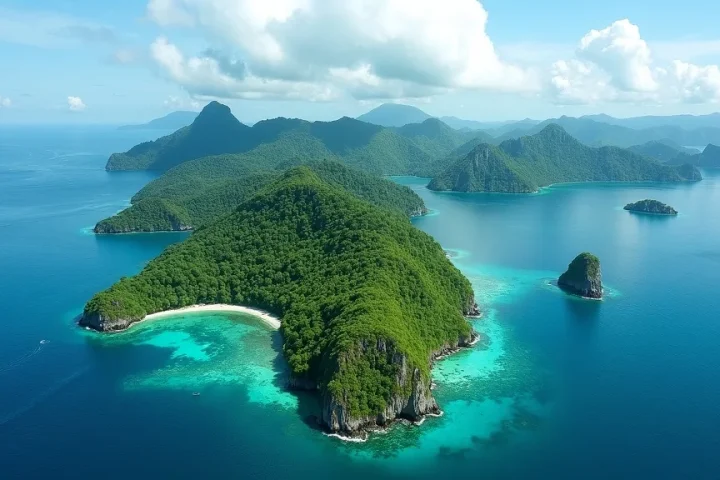
Short answer: Misool’s privately managed reserve — around 120,000 hectares of no-take zone inside Raja Ampat’s roughly one-million-hectare marine protected area network — contains marine lakes holding jellyfish and a labyrinth of hidden lagoons reached through gaps in the limestone. Access is genuinely managed: some lakes are open, some are closed on conservation grounds, and the answer can change between seasons. Nobody can promise you a specific lake on a specific day, and an operator who does is not reading the rules.
What is a jellyfish lake?
A marine lake is a body of seawater trapped inside limestone, connected to the sea only through fissures in the rock. Over time the isolation produces its own ecosystem. Where there are no significant predators, jellyfish populations can grow dense — and, over generations, some populations lose the potency of their sting almost entirely.
Floating among them is one of the strangest sensations in Indonesian travel. The water is warm, still and slightly green; there is no current, no depth pressure, no reef noise. Hundreds of soft translucent bells drift past your mask at a walking pace.
Palau’s jellyfish lake is the famous example. Misool’s are less publicised, less visited, and more strictly protected — and that combination is exactly why they are worth the transit.
Why are the access rules so strict?
Because a marine lake is the most fragile thing in Raja Ampat. It is small, enclosed, thermally sensitive, and has no mechanism for recovery if its population crashes. A single boatload of careless swimmers can do damage that takes years to undo, and closures elsewhere in the world have followed exactly that pattern.
Misool sits inside a privately managed reserve with a no-take zone of roughly 120,000 hectares. That governance is the reason the reefs here are in the condition they are in, and it comes with rules that are enforced rather than suggested. Sometimes those rules mean a lake is simply closed. That is the system working, not an inconvenience.
The wider conduct framework — shark and manta sanctuary status, no touching, no gloves, no feeding, plastic restrictions — is set out in our guide to Raja Ampat’s rules for visitors in 2027.
| Site | Activity | Access constraint |
|---|---|---|
| Marine lakes (jellyfish) | Snorkel / float, no fins where restricted | Conservation-managed; may be closed at short notice |
| Hidden Bay lagoons | Kayak, tender, quiet paddle | Tide-dependent entry through narrow limestone gaps |
| Karst channels and passages | Kayak, small-boat exploration | Passable only at certain tide heights |
| Reserve reefs (Boo, Nudi Rock, Fiabacet) | Diving and snorkelling | No-take zone rules; guide-led |
| Magic Mountain seamount | Diving | Current-dependent; moderate to strong |
What is Hidden Bay actually like?
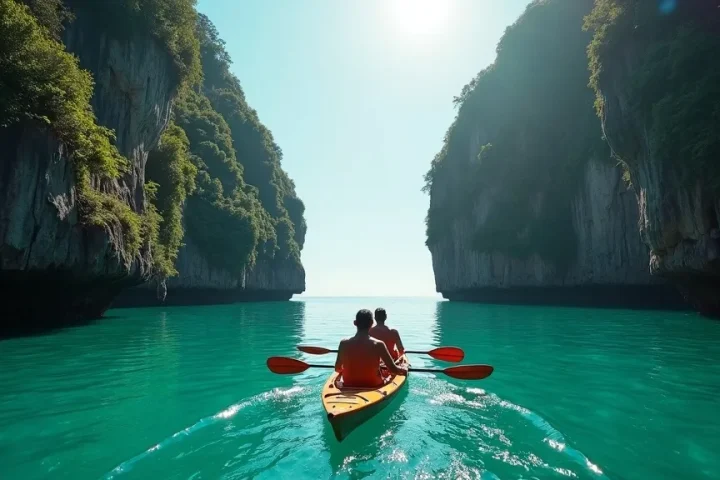
Quiet in a way that surprises people who have spent a week around dive tenders. Hidden Bay is a system of enclosed lagoons behind the outer karst, reached through gaps that are only passable at certain tide heights — which is why your cruise director will schedule it by the tide table rather than by the day.
The right way to see it is by kayak at dawn: still jade water, undercut limestone walls, and the sound of nothing much at all. It is the counterweight to Misool’s diving, which is some of the most demanding in the archipelago.
For non-divers on a mixed charter this stretch is often the highlight of the entire trip — the argument we set out on our non-diver snorkelling cruise page.
How should you behave in an enclosed lake?
Treat it as the most fragile water you will enter all week, because it is.
- No fins where the guide restricts them — a fin kick in a shallow lake stirs sediment and shreds jellyfish.
- No touching, no lifting, no holding. Jellyfish are structurally delicate; a hand under a bell does real damage.
- No sunscreen going in. Apply well in advance, or better, cover up with a rash guard instead. Chemicals accumulate in a body of water with no flushing.
- Enter slowly and float. The lake rewards stillness; swimming through it achieves nothing except turbidity.
- Take nothing out. No shells, no rock, no water samples.
- Keep group sizes small and accept staggered entry if the guide asks for it.
How do you get to Misool?
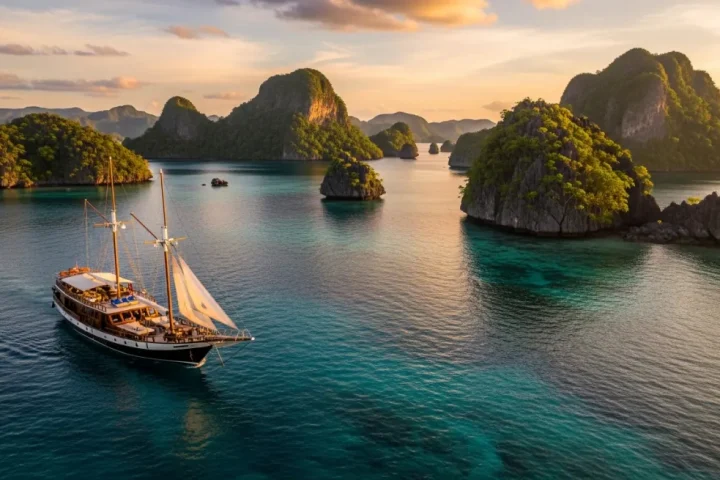
By boat, overnight. Misool lies far to the south — a passage on the order of ten to twelve hours from Sorong for a phinisi cruising at 8–9 knots, which is why it is always run through the dark. There is no day-trip version of this from the Dampier Strait, and no four-night itinerary reaches it.
That transit is the filter that keeps Misool as good as it is. Fewer boats make the journey, the reserve enforces its own rules, and the reefs show it. The full southern route — Boo Windows, Four Kings, Nudi Rock, Fiabacet, Magic Mountain, the lakes and the lagoons — is the substance of our Misool phinisi charter.
If you want Misool and the northern karst of Wayag in one voyage, you need length rather than optimism: the 11-night grand voyage exists because the archipelago is bigger than most itineraries admit.
What else does the southern reserve offer?
Diving that stands with anything in Indonesia. Magic Mountain is one of Raja Ampat’s most reliable manta sites, with a ridge top at 7–15 m dropping past 30 m and both reef and oceanic mantas in moderate to strong current — compared side by side with the Dampier alternative in our piece on Manta Sandy versus Magic Mountain. Boo Windows offers two swim-through openings at roughly 5–15 m with walls to 25–30 m and heavy soft coral. Nudi Rock runs 10–30 m with sea fans, pygmy seahorses and the nudibranchs it is named for.
One naming note, because it matters and it is a reliable test of an itinerary’s authorship: “Batu Bolong” is a Komodo dive site, not a Misool one. Misool’s arch and pinnacle sites have their own names. If you see Batu Bolong listed on a Misool programme, that programme has been copied from somewhere else.
Frequently asked questions
Do the jellyfish sting?
In isolated marine lakes the resident populations are typically harmless to humans. Follow the guide’s briefing, cover up rather than relying on sunscreen, and do not handle them.
Can I be guaranteed a jellyfish lake visit?
No. Access is conservation-managed and can be restricted or closed. Any itinerary presenting it as certain is overpromising.
Do I need to dive to see this?
No. The lakes and lagoons are snorkelling, floating and kayaking — among the best non-diving experiences in Raja Ampat.
Is there an extra fee?
Site and reserve contributions apply in Misool and are normally handled by the boat, separate from the marine park conservation fee covered in our permit guide.
What is the best season for Misool?
Broadly the main liveaboard season, October to April/May, though Misool’s manta window runs longer — roughly September to June.
How many nights do I need?
Six as a realistic minimum given the overnight transit each way; seven or more to do the reserve justice.
Sailing south to the reserve
If the lakes and lagoons are what you have come for, say so at the enquiry stage — it sets both the route and the minimum length of the charter, and we will tell you honestly what access looks like for your dates. Charters here are operated by Komodo Luxury, part of Juara Holding Group, sailing Indonesian waters since 2015. WhatsApp +62 811 3823 875 or email [email protected].