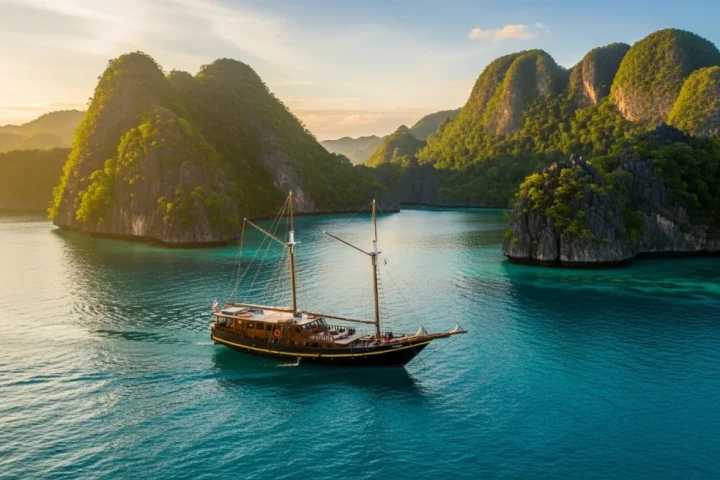
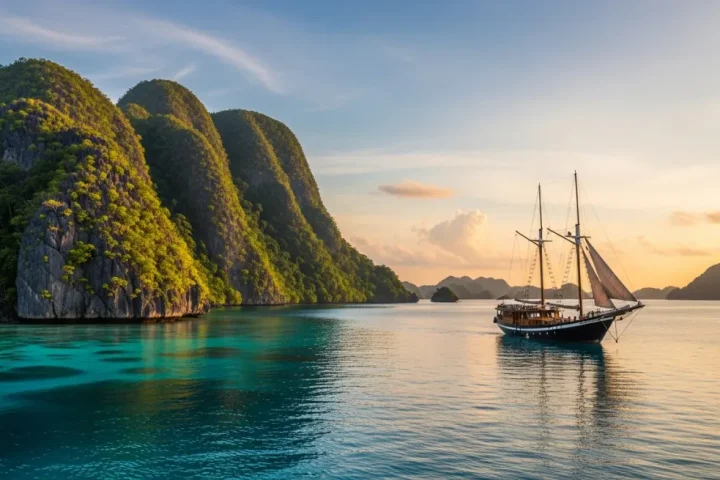
Short answer: Both, if your itinerary is long enough. Manta Sandy is the Dampier Strait’s reliable cleaning station — a sandy bottom at 14–18 m with moderate current, dived as a stationary observation dive behind a marked line, strongest roughly November to April and peaking December to February. Magic Mountain (Karang Bayangan) is Misool’s seamount — a ridge top at 7–15 m falling past 30 m, moderate to strong current, and reliable for reef and oceanic mantas roughly September to June.
What is the difference between the two sites?
| Site | Region | Depth | Current | Season window | Manta type |
|---|---|---|---|---|---|
| Manta Sandy | Dampier Strait, channel between Mansuar and Arborek | 14–18 m sand with cleaning bommies | Moderate | ~Nov–Apr, peak Dec–Feb | Reef manta |
| Magic Mountain (Karang Bayangan) | Misool, south Raja Ampat | Ridge top 7–15 m, wall past 30 m | Moderate to strong | ~Sep–Jun | Reef and oceanic manta |
| Blue Magic | Dampier Strait seamount | Pinnacle top 10–15 m to ~30–36 m | Medium to very strong | Aligned with Dampier season | Reef and oceanic manta at cleaning stations |
The structural difference matters more than the map. Manta Sandy is a cleaning station on flat sand: you settle, you wait, the mantas come to be cleaned and you watch them queue. Magic Mountain is a seamount in current: the mantas hold station in the flow above a ridge, and you are working to stay put while they hang effortlessly in front of you. One is a patient dive; the other is an athletic one.
When is manta season in Raja Ampat?
In the Dampier Strait, roughly November through April, with the strongest concentration December to February. That coincides neatly with the main liveaboard season, which runs about October to April or May before most boats reposition between June and September.
In Misool, Magic Mountain runs a longer window — roughly September to June. That is one of the quiet arguments for a southern itinerary in the shoulder months, when the Dampier cleaning stations are less predictable but Misool is still working.
Neither is a guarantee. Mantas are wild animals responding to plankton and tide, and any operator promising a sighting is telling you something about their honesty rather than about the reef. What a good itinerary buys you is repeat attempts — the ability to dive Manta Sandy three times across a week rather than once on a day trip. Our month-by-month weather and sea-state guide sets out how each month behaves.
How is Manta Sandy dived?
As a stationary observation dive, and the etiquette is not optional. There is a marked line on the sand, and divers stay behind it. You settle on the sand or rubble — not on coral — keep low, keep still, and let the animals use the cleaning bommies without interference.
The mistakes that ruin it are predictable: swimming out to meet a manta, drifting over the cleaning station, crowding the bommie, or surfacing bubbles directly under an approaching animal. A manta that is disturbed leaves, and it leaves for everyone on the dive, including the divers who behaved.
Depth is a comfortable 14–18 m, which means long bottom times — the reason this dive rewards patience. The reef mantas here have individual belly patterns, and guides on boats that dive the site weekly often recognise regulars by name.
How is Magic Mountain different in practice?
Harder, and more spectacular for it. The ridge top sits at 7–15 m with the wall dropping past 30 m, and the current that makes the site work is the same current you are fighting. Reef hooks earn their place here.
What Magic Mountain offers that Manta Sandy does not is the chance of oceanic mantas — the larger pelagic species — alongside reef mantas, at cleaning stations on the ridge. Add the general Misool bonus of dense soft coral and sea fans, and the southern reserve makes a strong case for itself. It is the centrepiece of our Misool phinisi charter.
The cost is transit. Misool lies far south of Sorong — on the order of ten to twelve hours for a cruising phinisi, which is why that leg is always run overnight. A four-night itinerary cannot reach it. This is a straightforward matter of arithmetic rather than salesmanship.
Which itinerary length do you need to get both?
Realistically, seven nights and up. A short central-Raja-Ampat trip gives you Manta Sandy and Blue Magic and no Misool. A southern trip gives you Magic Mountain and less Dampier time. Combining both means accepting one long overnight transit each way, which only makes sense when there are enough nights left over to justify it.
- 4 nights: Dampier Strait only. Manta Sandy and Blue Magic, no Misool.
- 6–7 nights: Central plus a genuine taste of the south, or central done thoroughly with repeat manta attempts.
- 8–11 nights: Both regions properly, with margin for weather and repeat dives at the sites that matter to you.
The Dampier-focused option is the Dampier Strait phinisi cruise; for both regions in one voyage, the longer packages are built for it.
What are the rules around mantas?
Raja Ampat’s waters were declared a shark, manta ray and dugong sanctuary — 2013 is the year normally cited, with the regulations drafted the year before. In practice that legal status translates into a short list of behaviours every guide will brief:
- Do not chase, follow or swim above a manta.
- Do not block its path or the approach to a cleaning station.
- Stay behind the marked line at Manta Sandy; stay low and still.
- No touching — ever, including a trailing hand as one passes.
- Gloves discouraged, buoyancy control expected, no feeding of anything.
The full picture, including plastic restrictions and drone etiquette, is in our guide to Raja Ampat’s rules for visitors in 2027.
Frequently asked questions
Am I guaranteed to see mantas?
No, and nobody can promise it. A well-planned week with multiple attempts at the right sites in the right months gives you very good odds — which is a different claim.
Can snorkellers see mantas?
At Manta Sandy the animals are at 14–18 m, so this is a diver’s site. Mantas do occasionally feed at the surface elsewhere in the strait, and a snorkeller in the right place at the right moment gets something extraordinary.
Is flash photography allowed?
Practice varies and some guides restrict it. Our position is simple: follow the guide’s briefing on the day, keep your distance, and never let the shot dictate your behaviour.
Which site is better for photography?
Manta Sandy for clean, stable, close-range compositions; Magic Mountain for dramatic wide-angle with a reef and blue water backdrop, if you can hold position.
What is the difference between reef and oceanic mantas?
Size and habits — oceanic mantas are substantially larger and more pelagic. Both are seen at Magic Mountain; Manta Sandy is a reef manta cleaning station.
Do I need advanced certification?
Not for Manta Sandy in normal conditions. Magic Mountain’s current makes experience genuinely useful — be honest with us about your logbook and we will plan accordingly.
Building the manta week
Tell us the month you can travel and we will tell you honestly which of the two sites should anchor your itinerary — and whether it is worth the transit to get both. Charters here are operated by Komodo Luxury, part of Juara Holding Group, sailing Indonesian waters since 2015. WhatsApp +62 811 3823 875 or email [email protected].