Short answer: Freedivers and underwater photographers need a boat built around timing, not around a schedule — golden-hour tender drops, repeat visits to the same site under different current, a dry charging bank, rinse tanks that are not shared with fins, and a crew that will move the anchor for the light. A private phinisi charter delivers that; a fixed-departure liveaboard rarely can. Plan 7–11 nights across the Dampier Strait, Fam and Misool. Indicative whole-boat market rates run from about USD 1,900 per night (8 guests) to USD 8,500 (14 guests). Booking desk: WhatsApp +62 811 3823 875.
What does a boat need to carry for photographers and freedivers?
| Requirement | Why it matters | Standard on mid-range phinisi |
|---|---|---|
| Dedicated camera table with padded top | Housing assembly and O-ring work needs a dry, stable surface | Usually — confirm per vessel |
| Separate camera rinse tank | Fins and masks in the same tank crack ports and dome glass | Yes on dive-configured boats |
| Charging bank with stable power | Strobes, drones, laptops; generators cycle on some vessels | Usually — ask about voltage and outlet count |
| Two tenders | Lets one group shoot golden hour while another dives | Common on 10-guest-plus vessels |
| Freedive-capable safety setup | Buoy, weighted line, trained safety in the water, oxygen on board | By arrangement — must be specified at booking |
| Starlink connectivity | Uploading and backing up between sites | Some upper-mid phinisi now carry it |
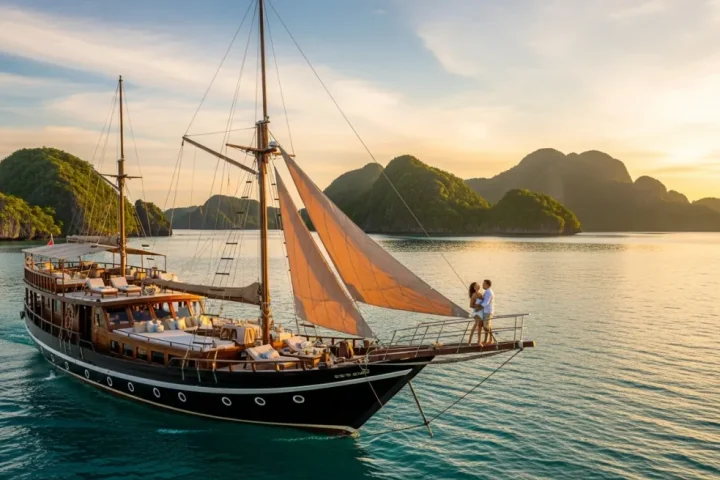
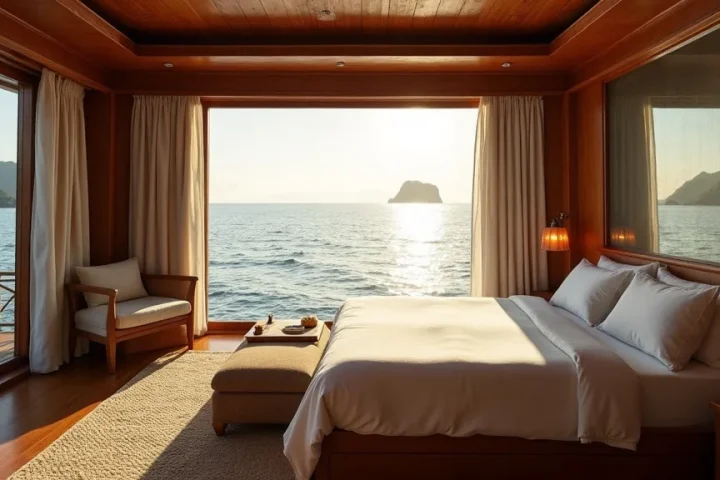
Vessels in this class run roughly 22–40 m with 4–7 cabins, 8–14 guests, en-suite bathrooms and individually controlled air conditioning — the air conditioning matters more than it sounds, because housings fog when a warm camera meets a cold cabin. Vessel-specific detail is on the fleet page.
Which sites suit which discipline?
| Site | Depth | Current | Best light | Discipline / lens |
|---|---|---|---|---|
| Melissa’s Garden (Fam) | 5–25 m | Light to moderate | Mid-morning, high sun on shallow coral | Freediving; wide angle |
| Friwen Wall | 2–25 m | Light | Morning | Freediving; wide angle, over-under |
| Mioskon shallows | 3–24 m | Mild to moderate | Late afternoon | Freediving; wobbegongs, turtles |
| Blue Magic | 10–36 m | Medium to very strong | Mid-morning at slack | Scuba wide angle — mantas, jacks |
| Cape Kri | 5–25 m | Often strong drift | Morning | Scuba wide angle — schooling fish |
| Manta Sandy | 14–18 m | Moderate | Any — stationary from the line | Scuba, wide angle, no approach |
| Boo Windows (Misool) | 5–30 m+ | Moderate to strong | Sun overhead for the swim-through beams | Scuba wide angle — the signature shot |
| Magic Mountain (Misool) | 7–30 m+ | Moderate to strong | Mid-morning | Scuba wide angle — mantas |
| Nudi Rock (Misool) | 10–30 m | Light to moderate | Any | Macro — pygmy seahorses, nudibranchs |
| Arborek Jetty | 0–20 m | Light | Late afternoon through the pilings | Macro and wide — batfish, sweetlips |
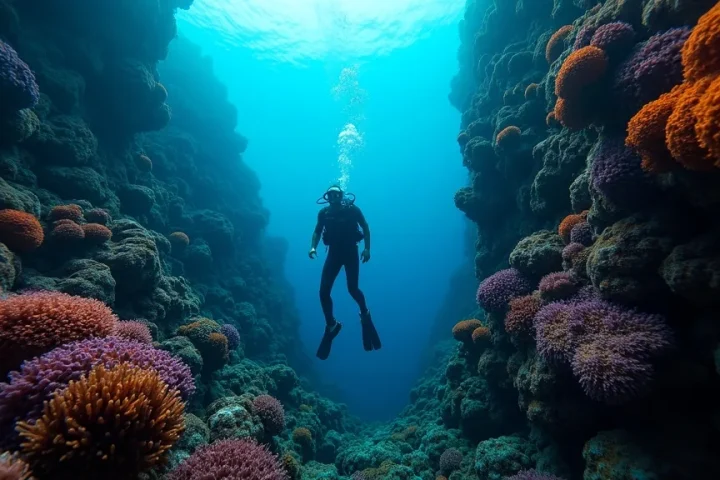
Water is 27–30 °C year-round, visibility is generally good through the main season, and the biological density is the point: Raja Ampat holds more than 550 reef-building coral species and more than 1,500 reef fish species, and Cape Kri carries the world’s most-cited single-dive fish count — 374 species logged by Dr Gerald R. Allen in 2012.
Why does a private charter beat a scheduled boat for imaging?
Three practical reasons. First, slack water and golden hour rarely coincide with a group’s dive schedule, and on a charter the schedule bends. Second, repetition — the shot you missed on Tuesday can be re-attempted on Wednesday at a different tide, which a fixed itinerary cannot offer. Third, tender autonomy: a photographer being dropped alone with a guide for a 90-minute shallow session is normal on a charter and disruptive on a shared boat.
For freedivers there is a fourth: safety protocol. Freediving in current needs a briefed buddy system, a fixed line where appropriate and a safety diver whose only job is you. That has to be arranged before the boat leaves Sorong, not negotiated on the dive deck. See our general private charter page for how we build bespoke programmes.
What about drones?
Aerials of Wayag, Piaynemo and the Fam lagoons are the reason many photographers come. Fly them with judgement: not over villages or people without permission, not over the Piaynemo platform while others are on it, and never at low altitude over nesting birds or manta aggregations. Raja Ampat’s communities hold customary rights over these islands, and goodwill on the water is worth more than any single frame. The Wayag expedition is the route with the best aerial subjects.
What does it cost?
Whole-boat market bands for Raja Ampat phinisi in 2026–2027 sit at roughly USD 1,900 per night for 8 guests, USD 5,500 for 10, USD 8,500 for 14, and USD 13,500–20,000 for ultra-luxury vessels. Add-ons relevant to this charter type — an extra tender, a dedicated safety freediver, extended nitrox, Starlink data — are quoted per vessel. Marine park and conservation fees apply on top: budget around USD 100 per person and confirm the current tariff near departure (permits and fees). Rate structure at charter rates.
Frequently asked questions
How many nights do photographers need?
Seven minimum for a serious portfolio, eleven if you want Misool’s soft coral and Wayag’s aerials in the same trip — the grand voyage.
Can freedivers and scuba divers share a charter?
Yes, with separated water time on the same sites. Mixing freedivers into an active scuba group at the same moment is a briefing problem, not a scheduling one, and we plan around it.
Is there oxygen and evacuation cover on board?
Emergency oxygen is standard on our dive-configured vessels. Insurance covering emergency evacuation is a condition of both diving and freediving with us — Raja Ampat is remote and the nearest recompression facilities are far away.
Can I charge and back up every night?
On mid-range vessels, yes, though generators may cycle. Bring a surge-protected multi-plug, spare batteries and two backup drives — assume no shore power for a week.
Is nitrox worth it for photography?
On three to four dives a day at 15–25 m, yes. It is normally a surcharge and availability is vessel-specific.
What is the best month for visibility?
The main liveaboard season, roughly October to April or May, is both the calmest and the clearest overall. Manta activity peaks December to February in the Dampier Strait and runs roughly September to June at Misool’s Magic Mountain.
Can we shoot Boo Windows with the sun beams?
That shot needs sun high enough to angle through the swim-throughs, so mid-day at Misool, current permitting. It is exactly the kind of window a private charter can wait for.
Do you allow strobes near mantas?
Strobes are permitted but discipline is enforced: no blocking, no chasing, no repeated firing at a cleaning station, and stay behind the marked line at Manta Sandy. Raja Ampat has been a declared shark and manta sanctuary since around 2013 and behaviour on these sites is watched.
Book a freediving or photography phinisi charter
Tell us your discipline, your target sites and your dates, and we will match a vessel with the right deck layout, tender count and crew. Komodo Luxury, part of Juara Holding Group, has run Indonesian liveaboards since 2015 — the wider fleet is at Komodo Luxury.
WhatsApp: +62 811 3823 875
Email: [email protected]
Related: Dampier Strait diving route · Misool south route · diving, guides and equipment
Photography charters and wedding work overlap more than you would expect. If a portrait session is part of the plan, see our notes on a Raja Ampat pre-wedding photoshoot by phinisi.