Short answer: It works, and it only works on a private charter — because a prewedding shoot needs the schedule to bend to the light, and a shared cabin itinerary bends to the dive plan. You need a boat you control, a route with karst and open deck, permission for the locations you want, and a realistic understanding that the best hours are 05:30 to 07:00 and 16:30 to sunset. Everything else is styling.
Why does a phinisi work so well for this?
Three reasons, and none of them is the boat’s luxury.
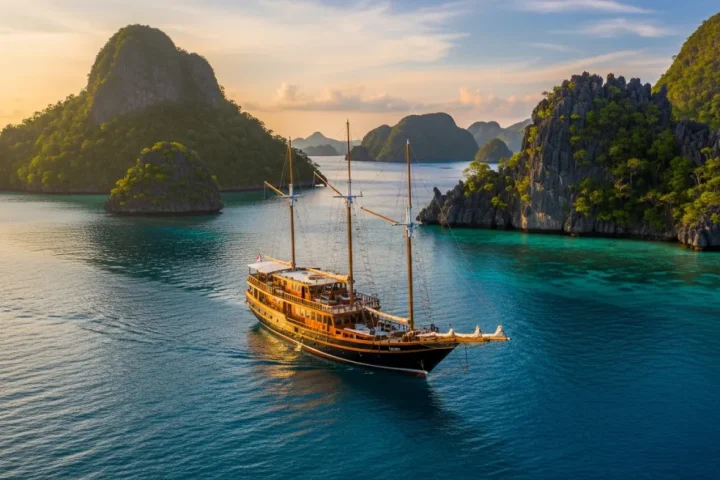
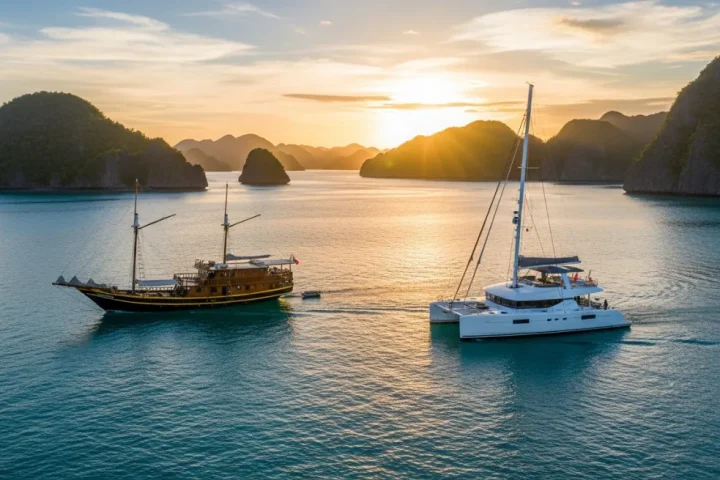
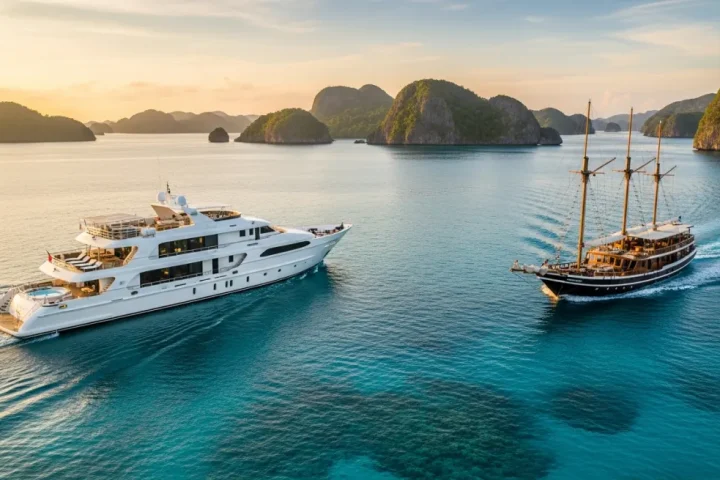
The lines. A traditional phinisi is a hand-built wooden schooner — a bowsprit, rigging, teak decks, sails. It photographs like nothing else afloat, and it does not read as a generic white yacht in a frame.
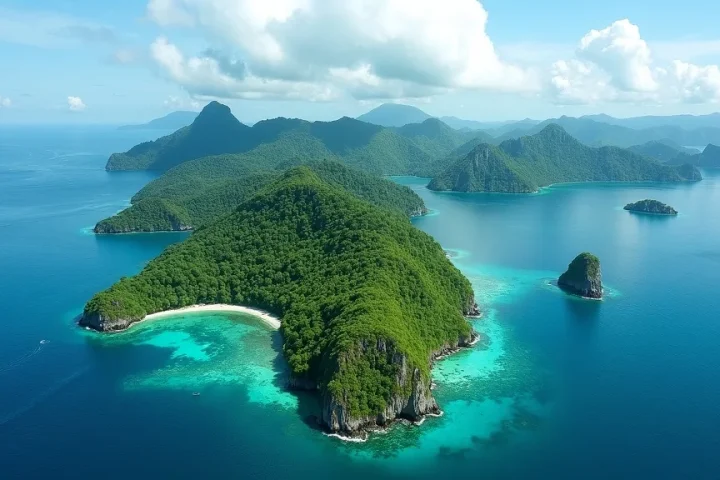
The backdrop. Raja Ampat’s karst is genuinely unusual: green cone-shaped islands scattered across pale water, across roughly 1,500 islands, cays and shoals. Piaynemo, the Fam lagoons and Kabui Bay give you three completely different looks within a short sail.
The control. This is the real one. On a private charter the boat goes where you ask, anchors where the light is, and waits while you shoot. No dive schedule, no other guests in the frame, no compromise about when the day starts.
Where do you actually shoot?
| Location | Best hour | Permission needed | Backup if weather turns |
|---|---|---|---|
| Phinisi deck and bowsprit | Golden hour, both ends of the day | None — it is your charter | Always available; shoot under cover in rain |
| Piaynemo viewpoint | Sunrise, before day boats arrive | Site access; drone permission separately | Fam lagoon from the water instead |
| Pasir Timbul sandbar | Low tide only — it appears and disappears | None, but tide-dependent | Any nearby beach; the sandbar cannot be conjured |
| Kabui Bay mangrove karst | Early morning, flat water | None for the water; ask locally near villages | Excellent in overcast — the fallback location |
| Village settings (Arborek, Sawinggrai) | Morning | Village permission, always | Skip rather than push |
| Underwater / in-water | High sun, 11:00–14:00 | Guide supervision | Shallow lagoon instead of reef |
Pasir Timbul deserves a note of its own: it is an emergent white sandbar that appears at low tide and is simply not there at high water. If it is on your shot list, the tide table dictates your day — not the other way round.
How do you time the light?
The same way anywhere near the equator, which is to say ruthlessly. Sunrise and sunset arrive quickly and the usable golden window is short — roughly forty-five minutes at each end. Between about 10:00 and 15:00 the light is directly overhead and unflattering for portraits, though excellent for anything in the water.
The practical shape of a shoot day: on deck at 05:00, shooting from first light, breakfast at 08:30, in-water or rest through the middle, back out at 16:30, done by dark. Two of those days gives you everything you need; three is comfortable.
Sleeping at the location is what makes the sunrise frame possible at all. A Piaynemo shoot run from a day boat cannot start before the crossing allows — the timing argument we make in full in our Piaynemo viewpoint guide.
What about wardrobe, hair and salt air?
Plan for humidity and wind, because both will win.
- Flowing fabrics photograph well in wind and pack badly. Bring a steamer or accept creases — there is no dry cleaner.
- Hair will not hold. Salt air and humidity defeat most styling within twenty minutes. Styles built around movement survive; structured ones do not.
- Bare feet on deck. Heels damage teak and are unusable on a tender or a limestone scramble.
- Two looks per session is realistic. Changing on a boat is quick; changing on a sandbar is not.
- Expect to get wet. Tender transfers, spray, and the shot where someone walks into the water. Bring a second dress if that shot matters.
- Sun protection between setups. Sunburn on the day before a wedding shoot is a genuine risk here.
What permissions do you need?
More than most couples expect, and asking is not optional.
Villages. These are inhabited Papuan communities, not sets. If you want to shoot in or near Arborek or Sawinggrai, permission comes first and a refusal is accepted gracefully. The etiquette is set out in our Arborek village guide.
Drones. Ask every time, and expect no over villages and crowded viewpoints. The aerial shot that circulates on social media was frequently taken before local attitudes hardened, and for good reason.
Conservation rules. They apply to a photoshoot exactly as they apply to a dive: no touching or standing on coral, no props left behind, no confetti, no floating flower arrangements, no single-use plastic. A biodegradable-looking prop is still litter in a marine protected area. Full details in our guide to Raja Ampat’s rules for visitors in 2027.
Should you bring your own photographer?
Usually yes, if the images matter. Bring the person who knows how you look and how you work together, and brief them properly on the environment: heat, salt, tender transfers, no charging guarantees overnight, no possibility of replacing a dropped lens.
Practicalities to agree in advance: who carries what into a tender, how gear is protected in spray, memory-card backup routine each evening, and whether the boat’s generator can support their charging needs. Connectivity for sending previews home is patchy at best — see our note on Starlink and signal in Raja Ampat.
A photographer is an extra berth and an extra head on the manifest. Say so at booking so the cabin plan works.
How far ahead should you plan a 2027 date?
Nine to twelve months for a peak-season week, which is the same lead time as any good phinisi in December to February. Shoulder months — October, March, April, May — are easier to secure and frequently calmer for shooting.
A realistic countdown: twelve months out, fix the month and hold the vessel. Six months out, confirm the photographer, the route and the shot list. Three months out, confirm wardrobe, permissions and any drone plans. One month out, book flights with a buffer night in Sorong. The week of, watch the tide table for Pasir Timbul.
The vessel matters as much as the date: you need deck space, a good bowsprit, privacy and a crew comfortable with a shoot rather than a dive schedule. Our honeymoon charter is built for couples, and the freediving and photography charter for anyone who wants the in-water frames done properly.
Frequently asked questions
Can we get legally married on board?
Indonesian marriage law is a separate matter from a ceremony or shoot. Most couples marry at home and use Raja Ampat for the imagery or a symbolic ceremony. Ask us early if you want the legal route explored.
How many days do we need?
Two shooting days on a three-night charter is the realistic minimum. Four nights gives you weather margin.
What if it rains?
Squalls are brief. Kabui Bay and the deck itself work in overcast, which is why they are the standing backup.
Can we use a drone?
Over open water with the crew’s agreement, often yes. Over villages and viewpoints, expect a refusal.
Is there a hair and makeup service?
Not on board. Bring your own or arrange it in Sorong before embarkation.
Can we do this alongside diving?
Yes on a private charter — shoot at the golden hours, dive in the middle of the day. It is one of the better arguments for chartering the whole boat.
Planning the shoot
Send us your dates, your shot list and whether you are bringing a photographer, and we will build a route around the light rather than around a dive schedule. Charters here are operated by Komodo Luxury, part of Juara Holding Group, sailing Indonesian waters since 2015. WhatsApp +62 811 3823 875 or email [email protected].