Short answer: Early-morning treks from Sawinggrai village on Gam Island give a genuine chance of seeing the Red Bird of Paradise (Paradisaea rubra) displaying in the canopy, and the nearby forests are also home to Wilson’s Bird of Paradise (Diphyllodes respublica). You leave the boat in the dark, walk twenty to forty minutes uphill, and sit still while the light comes up. Sightings are likely, not certain — and the birds are usually high, backlit and moving.
What makes Sawinggrai worth an alarm at 04:30?
Because birds of paradise display at first light and stop shortly afterwards. There is no afternoon version of this. The males gather at traditional display trees — the same trees, year after year — and perform in the twenty or thirty minutes when the sun is coming through the canopy. Arrive at eight and you will have a pleasant walk in the forest and see nothing.
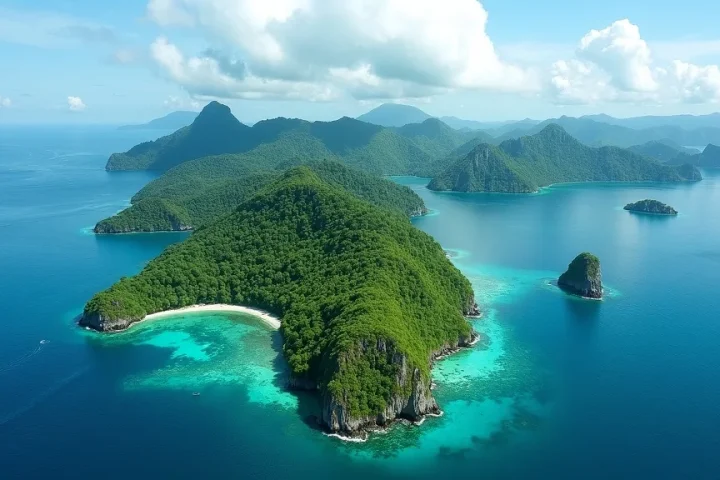
It is also, for many guests, the moment Raja Ampat stops being purely a marine destination. The archipelago’s reputation is built on reefs, but these are New Guinean islands, and the forest above the waterline belongs to a completely different biogeographic story. Standing in it at dawn listening to a bird whose plumage triggered a nineteenth-century fashion catastrophe is a genuinely different kind of travel from a dive briefing.
What does the morning actually look like?
Roughly this, allowing for variation between vessels and villages:
- 04:30–05:00 — coffee on deck, tender ashore in the dark.
- 05:00–05:30 — meet the village guide; a short briefing about silence and where to stand.
- 05:30–06:00 — walk. Twenty to forty minutes, uphill, humid, on an earth path that is slippery after rain.
- 06:00–07:00 — the wait at the viewing spot. This is the part that decides your morning: you sit, you stop talking, and you let the forest forget you are there.
- 07:00–08:00 — walk down, often through the village, back to the boat for a late breakfast.
| Species | Best hour | Difficulty | Photography note |
|---|---|---|---|
| Red Bird of Paradise (Paradisaea rubra) | First light, ~05:45–07:00 | Moderate walk, patient wait | High in the canopy and backlit — 300 mm+ and high ISO; expect silhouettes |
| Wilson’s Bird of Paradise (Diphyllodes respublica) | First light, at a cleared display court | Harder — a hide, longer stillness | Low and close but very dark; fast glass matters more than reach |
| Hornbills, cockatoos, lories | Dawn and dusk | Easy — often from the deck | Flight shots; often the easiest good photograph of the trip |
| Forest kingfishers, fruit doves | Morning | Easy | Opportunistic; a good guide will point them out on the walk |
Will you definitely see one?
No, and we will not pretend otherwise. These are wild birds at natural display trees, not a managed attraction. Local guides who walk these paths every week know which trees are active this month, which is why a village guide raises your odds far more than any equipment you bring.
What we can say honestly: at an active display tree, in the right hour, with a group that stays quiet, sightings are common. Photographs good enough to print are much rarer — the birds are high, the light is minimal, and the canopy is dense. Go for the experience and treat any usable frame as a bonus.
What is the etiquette in the village?
Sawinggrai is a home, not a facility. The forest is community land and access exists because the community allows it — and, importantly, because birds seen by visitors are worth more alive than they were to the plume trade a century ago.
- Take the village guide. Not optional in practice, and the guide fee is part of how conservation pays for itself here. Your boat will arrange it.
- Silence at the display tree. Whispers carry. Phones on silent, not vibrate.
- No flash, no playback. Calling birds in with recordings is disruptive and increasingly frowned upon.
- Dress modestly ashore — shoulders and knees covered walking through the village, even at dawn.
- Ask before photographing people, especially children, and accept a refusal without argument.
- Bring nothing disposable. Single-use plastic is restricted across the regency; carry a refillable bottle and take everything back to the boat.
The same principles apply at every inhabited stop in the Dampier Strait — we cover them in detail in our Arborek village and jetty guide.
What should you wear and carry?
Closed shoes with grip — the path is earth and root, and it is slick after overnight rain. Long trousers and a long-sleeved layer, both for mosquitoes and for the scratchy understorey. Insect repellent applied before you leave the boat, not at the trailhead. A head torch, because you will be walking in genuine darkness. Water. A small dry bag if you are carrying a camera, because it will rain on somebody’s trek this week.
Leave the tripod. There is no room for it at a viewing spot and no time to set it up. What actually earns its place in a Raja Ampat bag is listed in our 2027 packing list.
Who is this excursion for?
Anyone who can manage a short uphill walk and sit still for an hour. It is one of the few Raja Ampat activities where non-divers get the better end of the deal — while the divers are doing an early tank, the birders are in the forest, and everyone is back on deck for breakfast with a story.
It works particularly well on mixed-interest trips, which is why we build it into itineraries designed around more than diving: the non-diver snorkelling cruise and the family phinisi charter both treat Gam’s forests as a headline rather than a filler.
Older children usually cope well with the walk and badly with the silence — be realistic about which of yours will manage an hour of stillness in the dark, and consider sending half the family.
Frequently asked questions
What time do we leave the boat?
Typically between 04:30 and 05:00, in the dark, to be in position for first light.
How long is the walk?
Usually twenty to forty minutes uphill each way on an earth path.
Which species will I see?
Red Bird of Paradise is the headline at Sawinggrai. Wilson’s Bird of Paradise occurs in the same region and is generally a harder, hide-based sighting.
Do I need a guide?
Yes — a village guide, arranged through the boat. They know which trees are active, and the fee supports the community that protects them.
Is it worth it if I do not have a long lens?
Yes. The display call carrying through a dark forest is most of the experience; the photograph is not.
Can this be combined with diving the same day?
Easily. You are back on board by mid-morning, in time for the day’s second water session.
Adding a dawn trek to your itinerary
Gam sits close to the classic Dampier Strait dive sites, so a Sawinggrai morning costs an itinerary almost nothing except an early alarm. Ask us to build it in. Charters here are operated by Komodo Luxury, part of Juara Holding Group, sailing Indonesian waters since 2015. WhatsApp +62 811 3823 875 or email [email protected].