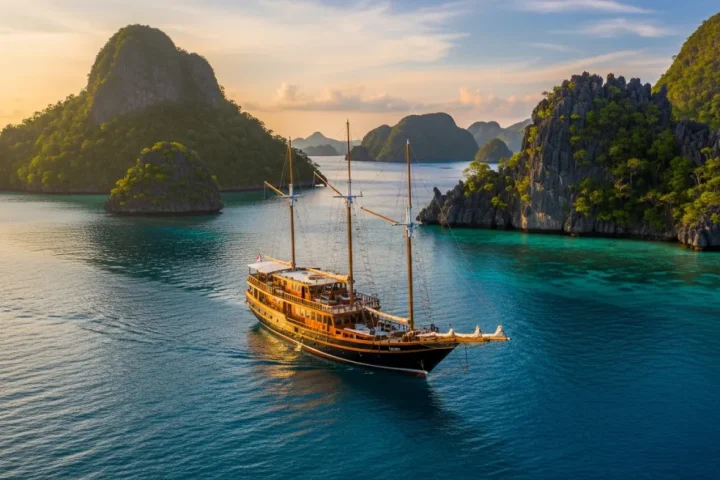
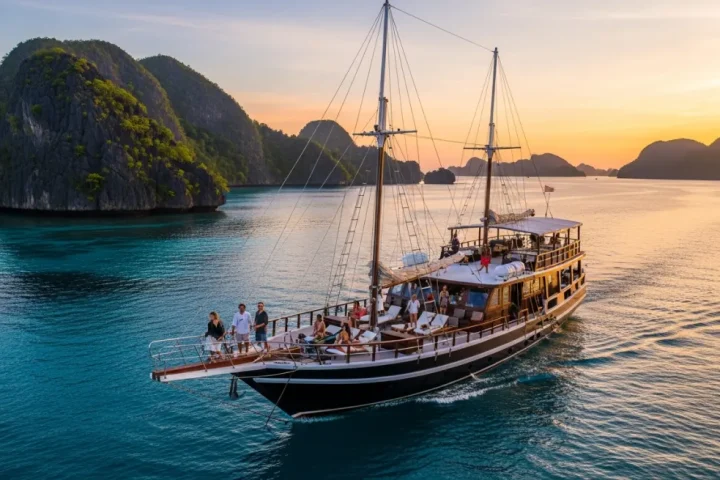
Short answer: Crossings exist because liveaboards have to move. Raja Ampat’s main season runs roughly October to April/May, and most boats reposition elsewhere in Indonesia between June and September — and rather than sail empty, they sell the repositioning legs as itineraries. Halmahera routes are commonly scheduled mid-year, and Banda Sea crossings between Ambon and Sorong are commonly scheduled around the seasonal turns. They are, night for night, some of the best value in Indonesian liveaboard diving.
What is a crossing itinerary?
A one-way voyage between two dive regions, usually longer than a standard cruise and usually embarking in one port and disembarking in another — Ambon to Sorong, or the reverse, being the classic Banda Sea pairing.
The logic is fleet logistics. A phinisi cruising at 8–9 knots takes days to move between Indonesia’s dive regions, and it has to do that twice a year. Selling those days as an expedition turns a delivery trip into a product, and the diving in between is not filler — the water the fleet crosses is some of the least-dived in the country.
| Leg | Commonly scheduled around | Headline feature |
|---|---|---|
| Raja Ampat season | Oct–Apr/May | Dampier Strait currents, Misool reserve, Wayag karst |
| Halmahera and the northern routes | Mid-year, as boats leave Raja Ampat | Volcanic islands, unusual macro, very low traffic |
| Banda Sea crossing (Ambon ↔ Sorong) | Seasonal turns, commonly around Oct–Nov | Banda islands, remote seamounts, open-water transits |
| Cenderawasih Bay | Trips commonly scheduled Jun–Oct | Whale sharks associating with bagan fishing platforms year-round |
Treat those windows as fleet patterns rather than a timetable. Crossing schedules are set boat by boat and change year to year — ask for actual 2027 departure dates rather than planning around a general season.
Why are crossings good value?
Because the boat is going anyway. A repositioning leg has to be crewed, fuelled and provisioned whether or not there are guests on it, so operators price these voyages to fill them. On a per-night basis they routinely undercut the same vessel’s peak-season Raja Ampat weeks.
You also get length. Crossings run longer than the standard six-to-twelve-night pattern, which changes the texture of the trip: enough days to stop counting them, enough sea time to properly settle into life on a boat, and enough sites to stop treating each one as a highlight to be captured.
And you get emptiness. These are routes the day-boat fleet cannot reach and the resort market does not serve. On a Banda leg you may go days without seeing another dive vessel — the same appeal that makes the far north of Raja Ampat worth the transit, as set out in our Wayag guide.
What is the diving actually like?
Different from Raja Ampat, and worth understanding before you assume it is an extension of it.
Raja Ampat’s signature is density — more than 550 coral species, over 1,500 reef fish species, and the current-fed biomass that produced the 374-species single-dive record at Cape Kri. It is a reef destination in the fullest sense.
The Banda Sea’s signature is depth and volume of water: isolated seamounts rising out of very deep ocean, walls, pelagics, and the sense of diving somewhere genuinely oceanic. Halmahera adds volcanic substrate and macro life you will not see in the Dampier Strait. Cenderawasih is different again — whale sharks associating year-round with the bagan fishing platforms, with trips commonly scheduled June to October.
Water throughout the region stays around 27–30 °C, but crossings often involve cooler, more exposed sites than a sheltered Raja Ampat week, so bring the warmer end of your exposure options.
Who does a crossing suit, and who does it not?
It suits experienced divers who have done a standard liveaboard week and want more; people who are comfortable with long open-water transits and can sleep on a moving boat; anyone chasing pelagics rather than macro; and travellers who value emptiness over convenience.
It does not suit first-time liveaboard guests, anyone prone to seasickness, families with young children, non-divers looking for beaches and villages, or anyone with a tight schedule — the one-way format means two sets of flights and less margin for delay.
That last point deserves emphasis. A crossing embarks in one city and disembarks in another, and the flight routing to and from eastern Indonesia is not forgiving. The buffer-day logic in our Sorong airport guide applies twice over.
Crossing or a Raja Ampat week?
If it is your first time in this part of Indonesia, do Raja Ampat properly. There is no version of a crossing that gives you Misool’s reserve, the Dampier Strait’s cleaning stations and Wayag’s karst, and those are the reasons most people come. Which month favours which route is set out in our month-by-month weather guide.
If you have already done that week and want the next thing, a crossing is the natural progression — and it pairs well with an add-on. Some guests build a crossing onto the front or back of a Raja Ampat charter; others link Raja Ampat with Komodo in a single extended plan, which is what our Komodo and Raja Ampat charter exists for.
For the longest single Raja Ampat voyage without leaving the archipelago, the 11-night grand voyage reaches both the northern and southern extremes — often the better answer for guests attracted to a crossing’s length but not to its transits.
How far ahead should you book one?
Early, for a reason that surprises people: crossings run once or twice a year per vessel, not weekly. A Raja Ampat week has dozens of alternatives if your first choice is full. A specific crossing on a specific boat has none.
Ask for 2027 dates as soon as they are published, check whether the price is per person in a shared cabin or whole-boat, and confirm what the one-way format means for your flights before you commit. Then read the fine print on cancellation, because a repositioning voyage cannot simply be moved to another week.
Frequently asked questions
What is a Banda Sea crossing?
A one-way repositioning voyage between dive regions — commonly Ambon and Sorong — sold as an expedition itinerary while the boat relocates for the season.
When do crossings run in 2027?
Around the seasonal turns, and vessel by vessel. Ask for published departure dates rather than assuming a month.
Are crossings cheaper?
Usually, per night, because the boat is repositioning regardless. Length means the total can still be substantial.
Do I need to be an experienced diver?
Yes, realistically. Open-water sites, current and long transits make this a poor first liveaboard.
Will I get seasick?
More likely than on a sheltered Raja Ampat week. If you know you are susceptible, this is not the itinerary for you.
Can non-divers come?
They can, but there is much less for them than on a Raja Ampat itinerary with villages, viewpoints and shallow reefs. We would steer non-divers elsewhere.
Asking about 2027 crossing dates
Crossing schedules are published vessel by vessel and fill quietly. Tell us the season you are thinking about and we will send the actual departures rather than a seasonal generalisation. Charters here are operated by Komodo Luxury, part of Juara Holding Group and an Indonesian phinisi operator since 2015. WhatsApp +62 811 3823 875 or email [email protected].