Short answer: The Dampier Strait’s legendary fish density is a by-product of current. You do not dive here despite the water moving — the water moving is why the fish are there. That means you plan around tides rather than against them, you enter negatively and on the guide’s signal, you carry a reef hook, and you accept that a good guide will move or cancel a dive when the stage of tide is wrong. Depths mostly run 5–30 m in 27–30 °C water.
Why is the Dampier Strait so rich?
Geography. The strait is a channel between Waigeo and the islands to its south, and every tide forces a large volume of water through a relatively narrow gap. That flow carries plankton; plankton concentrates on the upcurrent faces of reefs and seamounts; fusiliers and anthias feed on it in their thousands; trevally, tuna, barracuda and reef sharks feed on them.
Layer that onto Raja Ampat’s baseline — more than 550 reef-building coral species, over 1,500 reef fish species — and you get the reef where Dr Gerald R. Allen logged 374 fish species in a single 90-minute dive at Cape Kri.
The corollary is unavoidable: the sites with the most fish are the sites with the most current. There is no version of the Dampier Strait that gives you the biomass without the flow.
What are the main sites and what do they demand?
| Site | Depth | Typical current | Entry technique |
|---|---|---|---|
| Cape Kri | 5–25 m, deeper options | Variable, often strong drift | Negative entry, drift, hook on the point |
| Blue Magic | Pinnacle top 10–15 m to 30–36 m | Medium to very strong | Negative entry straight onto the pinnacle; hook |
| Sardine Reef | 10–30+ m | Strong | Negative entry, drift; hook to watch the schools |
| Manta Sandy | 14–18 m sand | Moderate | Descend and settle behind the line; stationary |
| Mioskon | To ~24 m | Mild to moderate | Standard entry; good check-out dive |
| Arborek jetty | Surface to 15–20 m | Mild | Easy entry; also a snorkel site |
| Melissa’s Garden (Fam) | 5–25 m | Light to moderate | Relaxed; exceptional hard coral |
Read that table as a ramp. A sensible week starts at Mioskon or Arborek, moves through Manta Sandy, and only then takes on Blue Magic and Sardine Reef when the guide has seen how the group handles moving water.
How do you dive current properly?
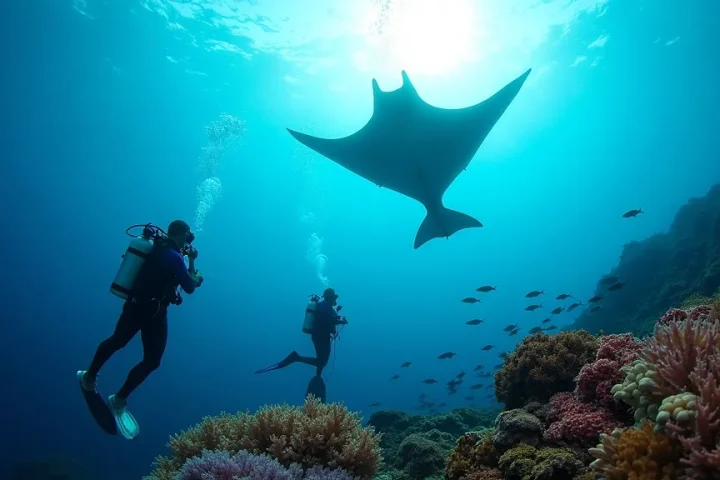
Negative entry. On the high-flow sites you go in with an empty BCD and no air in your suit, and you descend immediately. A minute spent bobbing on the surface at Blue Magic is a minute of being carried past the pinnacle you came to dive. Weight yourself correctly for this before you attempt it.
Reef hook, used correctly. Hook into dead rock, rubble or a bare ledge — never into living coral, never into a sea fan. Deploy a short line, hover slightly above the substrate, and stay off the reef. A reef hook used badly does more damage in one dive than a hundred careful divers repair in a season.
Stay low and use the terrain. Current is weakest in the lee of structure and along the bottom. Working from bommie to bommie in the shelter of the reef costs a fraction of the air of swimming in the flow.
Stay with the group. In drift, separation happens in seconds. Agree the plan in the briefing, know where the tender will be, and carry an SMB and a whistle. Every diver, every dive.
Do not fight it. The single most common mistake is finning hard against a current you cannot beat. Turn, drift, and let the guide reposition the group.
When does a guide call a dive off?
When the tide is wrong for the site, when a downcurrent is running on a pinnacle, when the sea state makes tender recovery unsafe, or when the group’s demonstrated skill does not match the conditions on that particular day. All four are routine and none is a failure.
This is worth understanding before you board, because it will happen at some point in your week and it can feel like a disappointment in the moment. A cruise director who moves the group from Blue Magic to Mioskon because the flood is running hard is doing their job. One who puts a mixed-experience group onto a seamount in a downcurrent because it was on the schedule is not.
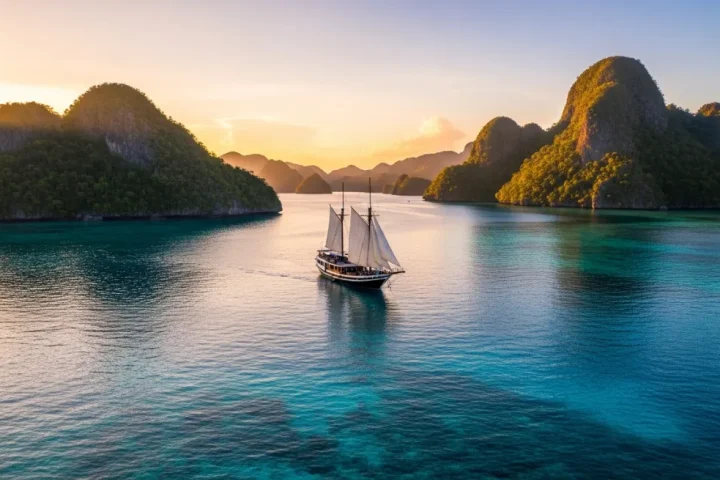
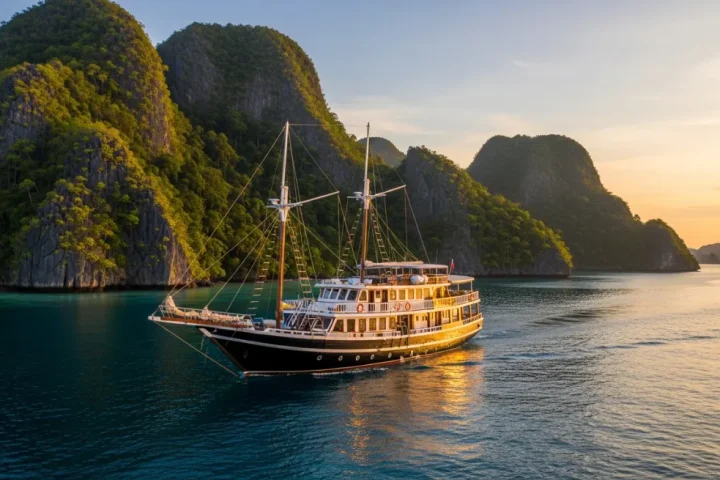
Sites get substituted for weather too, particularly in the north. That flexibility is standard on every itinerary we run, including the Dampier Strait phinisi cruise.
How much diving does a week actually give you?
A seven-night liveaboard week typically delivers 18–25+ dives across 12–18 sites, at three to four dives per day including night dives. That volume is the real argument for a liveaboard over a resort: repetition on the same sites at different tide stages, which is how you finally see Blue Magic properly rather than once, badly, at the wrong hour.
It also has consequences for your body and your gas planning. Multi-day repetitive diving at 20–30 m in current is where nitrox stops being a luxury, and where conservative profiles matter. Our 8D7N phinisi package is built around that rhythm, and the deck logistics that support it — stations, tenders, nitrox — are set out in inside a phinisi dive deck.
Who should build up first?
Let us be direct, because the wrong answer here spoils holidays. Raja Ampat is a poor destination for a diver with a handful of logged dives and no current experience. The certification card matters less than three things: buoyancy control good enough to hover without touching anything, comfort with a negative entry, and the honesty to say you are uncomfortable before the dive rather than during it.
If that is not you yet, there are two good options. Build experience elsewhere first, or come on an itinerary that is honest about which sites you will and will not dive — there is a full week of world-class diving here in the moderate-current bracket, and Melissa’s Garden, Arborek and Mioskon are not consolation prizes.
Tell us your real logbook at booking. It changes the dive plan, not the welcome. What it must not change is the safety margin — see our insurance and evacuation checklist for why remoteness raises the stakes on every judgement call out here.
Frequently asked questions
Do I need a reef hook in Raja Ampat?
On the high-current Dampier sites, yes. Most boats can lend one; bring your own if you prefer a familiar line length.
How strong does the current actually get?
Strong enough that you cannot swim against it at Blue Magic or Sardine Reef on a running tide. That is precisely why guides dive them on the correct stage.
Is nitrox available?
Usually yes, typically at surcharge. On a 3–4 dive-a-day week it is worth taking if you are certified.
What wetsuit do I need?
Water is 27–30 °C year-round. A 3 mm or a shorty suits most divers; repetitive diving makes people colder than they expect, so err warmer.
Are there downcurrents?
Yes, particularly around seamounts and drop-offs. The response is to move horizontally into the reef and away from the blue, not to fight vertically.
Can a nervous diver enjoy the Dampier Strait?
Genuinely, yes — on the right sites, at the right tide, with a guide who has been told the truth about your experience.
Planning a dive week that matches your experience
Send us your certification level, logged dives and recent diving, and we will map an itinerary that ramps rather than throws. Charters on this site are operated by Komodo Luxury, part of Juara Holding Group and an Indonesian liveaboard operator since 2015. WhatsApp +62 811 3823 875 or email [email protected].